Cal Poly Global Site Tag

Google Tag Manager


AI Day Posters

CAL POLY AI DAY  ·  GRADUATE EDUCATION

Student Research Poster Showcase

36 student presenters  ·  35 posters  ·  six colleges  ·  undergraduate and graduate research in artificial intelligence

Thursday, October 22, 2026  ·  Swanson Center of Effort Conference Hall
QR code to this page
SCAN TO SHARE
EXCELLENCE THROUGH EXPERIENCE
Browse the research and meet the researchers. Presenters are grouped by level and listed alphabetically by presenting author; co-authors are credited beneath each title. Each preview opens the full poster.
How to find a poster: use the name index under each section heading, or browse by college below.
  Undergraduate  (28)       Graduate  (7)  
BY COLLEGE
College of Agriculture, Food and Environmental Sciences (3)  ·  College of Architecture and Environmental Design (3)  ·  College of Engineering (14)  ·  College of Liberal Arts (7)  ·  College of Science and Mathematics (5)  ·  Orfalea College of Business (3)
Cal Poly sign on campus

SECTION ONE


Undergraduate Research   28 posters, alphabetical by presenting author

Agrawal  ·  Alexander  ·  Allen  ·  Au  ·  Blam  ·  Bogosian  ·  Cea  ·  Goel  ·  Gupta  ·  Hopping  ·  Kim  ·  Koduru  ·  Kolar  ·  Korbey  ·  Kullar  ·  Le  ·  Loganathan  ·  Lowe  ·  Luis  ·  Morales  ·  Mui  ·  Novack  ·  O'Connell  ·  Pickrell  ·  Reyes  ·  Soto  ·  Tieu  ·  Tovar
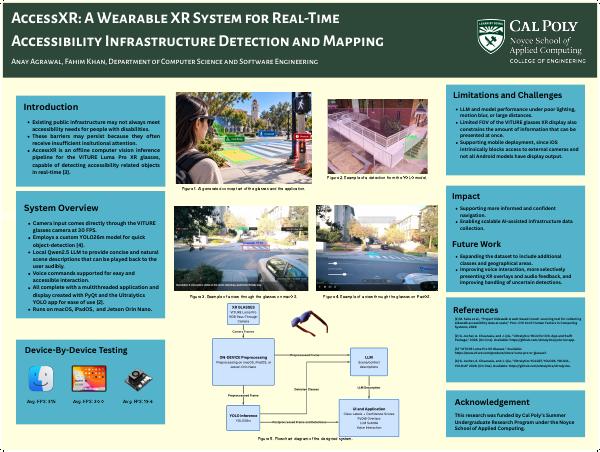
Anay Agrawal AccessXR: A Wearable XR System for Real-Time Accessibility Infrastructure Detection and Mapping
PRESENTER
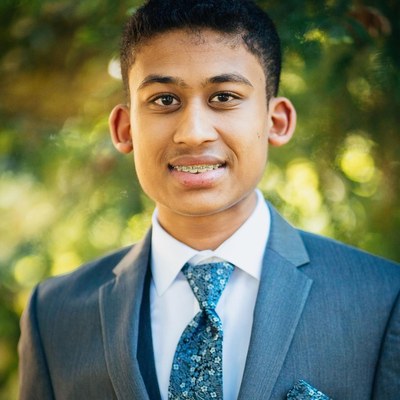
Anay Agrawal  LinkedIn
Computer Engineering (B.S.)  ·  College of Engineering
Faculty advisor: Fahim Khan

Anay Agrawal is a 2nd year Computer Engineering student whose research interests include artificial intelligence, real-time systems, and performance optimization. This project was completed as part of SURP 2026

ABSTRACT
Accessibility barriers in the built environment can create significant mobility challenges for people with disabilities, motivating technologies that can identify, document, and help people navigate accessibility-related infrastructure. We present AccessXR, a wearable extended reality (XR) system that combines real-time computer vision and hands-free interaction to detect and document accessibility-related features in the environment. Read the full abstract on the poster.


Poster preview
 
  View Poster (PDF)  
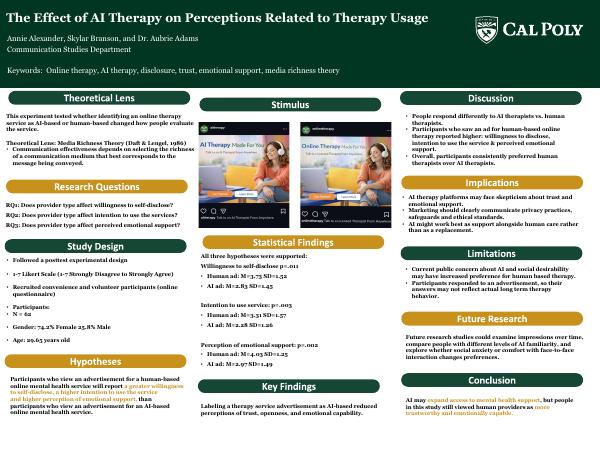
Annie Alexander The Effect of AI Therapy on Perceptions Related to Therapy Usage
PRESENTER
Annie Alexander  LinkedIn
Co-author: Skylar Branson
Communication Studies (B.A.)  ·  College of Liberal Arts
Faculty advisor: Aubrie Adams

Annie Alexander and co-author Skylar Branson are Communication Studies students with an interest in media effects, digital communication, and how emerging technologies shape people’s everyday decisions. Their research explores how people respond to AI-based versus human-based online therapy services, with a focus on trust, self-disclosure, and perceived emotional support.

ABSTRACT
This study examines how AI-based versus human-based online therapy providers affect perceptions of therapy use. In a posttest-only experiment, 62 participants viewed a mock social-media advertisement for either an AI or human-led service and rated their willingness to self-disclose, intention to use the service, and perceptions of emotional support. Participants rated the human-based service significantly higher across all three measures. Read the full abstract on the poster.


Poster preview
 
  View Poster (PDF)  
Rafi Allen Deep Reinforcement Learning Algorithms for Quadrotor Hover and Trajectory Tracking in a Digital Twin
PRESENTER
Rafi Allen  LinkedIn
Electrical Engineering (B.S.)  ·  College of Engineering
Faculty advisor: Siavash Farzan

Rafi Allen is a 4th year Electrical Engineering student who is interested in reinforcement learning, multi-agent systems, and autonomous control. Current work explores deep reinforcement learning for Crazyflie hover and trajectory tracking in a digital twin, including a controlled comparison of PPO, SAC, and TD3. Allen is also developing a real-time excitation monitor to assess the reliability of cooperative localization in a team of Crazyflie drones, with the broader goal of contributing to safe, reliable multi-robot autonomy.

ABSTRACT
Deep reinforcement learning (RL) is a promising alternative to classical feedback control for agile aerial robots. However, published comparisons between RL algorithms are often confounded by differences in task design, network architecture, and training pipeline. Read the full abstract on the poster.
 
  Poster PDF coming soon  
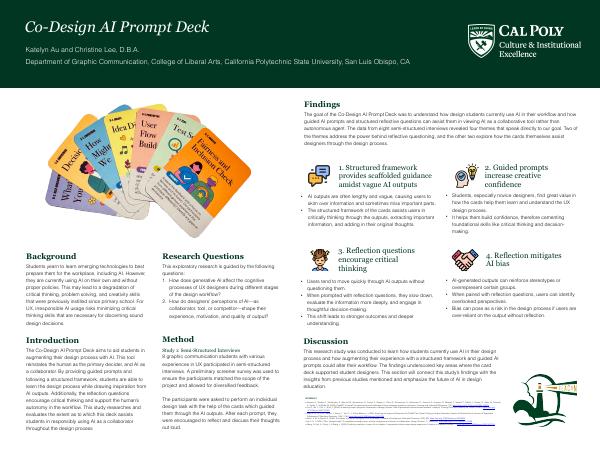
Katelyn Au Usability Findings of Co-Design AI prompt Deck
PRESENTER
Katelyn Au  LinkedIn
Graphic Communication (B.S.)  ·  College of Liberal Arts
Faculty advisor: Christine Lee

Katelyn Au is a 4th year Graphic Communication student who is concentrating in User Interface/User Experience. She has developed her skills beyond the classroom through internships, research, and in a UX design club. In her last year, she hopes to help students as a Teaching Assistant in the Experience Design course while completing her senior capstone project.

ABSTRACT
Students today are using artificial intelligence (AI) for studying, writing, and creative projects. Though powerful, these tools are often adopted uncritically, without reflection on limitations or ethical dilemmas they create. Furthermore, this research explores how the Co-Design AI Prompt Deck, a set of cards with prompts and reflections, would encourage students to analyze biases and reasoning that might otherwise remain implicit. Read the full abstract on the poster.


Poster preview
 
  View Poster (PDF)  
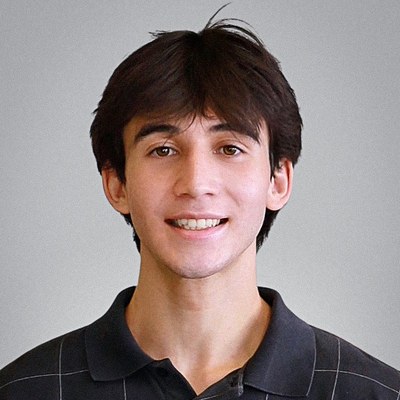
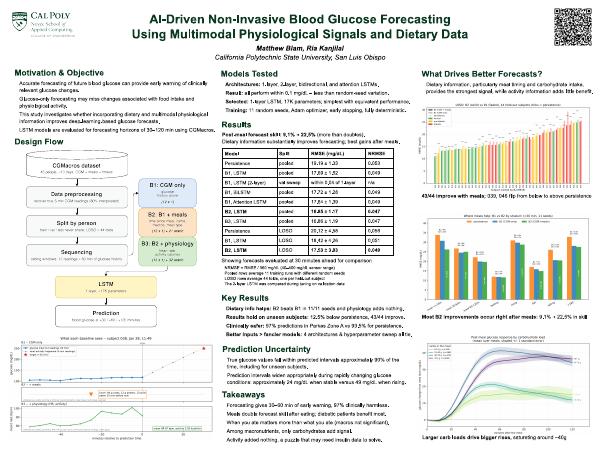
Matthew Blam AI-Driven Non-Invasive Blood Glucose Forecasting Using Multimodal Physiological Signals and Dietary Data
PRESENTER
Matthew Blam  LinkedIn
Computer Science (B.S.)  ·  College of Engineering
Faculty advisor: Ria Kanjilal

Matthew Blam is a 3rd year Computer Science student with a passion for building software that solves real-world problems. He is particularly interested in exploring applications of artificial intelligence and machine learning in healthcare to improve patient outcomes and make healthcare more accessible. His software engineering experience spans full-stack development, mobile applications, and automation, with upcoming internships at Astranis and Impulse Space. Outside of academics, Matthew leads Cal Poly's chapters of Hack4Impact and The Diabetes Link and enjoys building practical tools and applications that make a meaningful impact.

ABSTRACT
Accurate forecasting of future blood glucose can provide early warning of clinically relevant glucose changes. Glucose-only forecasting may miss changes associated with food intake and physiological activity. This study investigates whether incorporating dietary and multimodal physiological information improves deep-learning-based glucose forecasts. LSTM models are evaluated for forecasting horizons of 30–120 min using CGMacros.


Poster preview
 
  View Poster (PDF)  
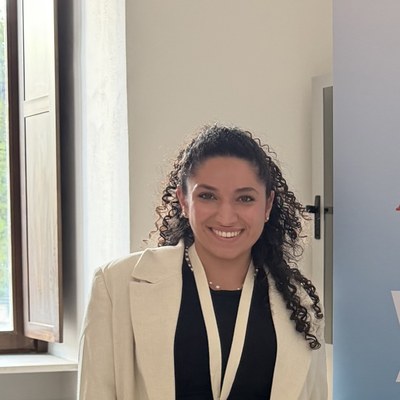
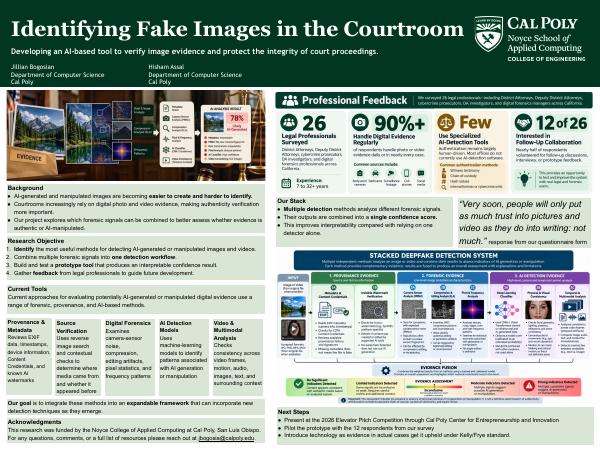
Jillian Bogosian Identifying Fake Images in the Courtroom
PRESENTER
Jillian Bogosian  LinkedIn
Computer Science (B.S.)  ·  College of Engineering
Faculty advisor: Hisham Assal

Jillian Bogosian is an undergraduate Computer Science student. Her research interests include artificial intelligence, augmented reality, and specifically the responsible use of AI in legal settings. Working with Dr. Hisham Assal, she is developing a proposed AI-based framework to help evaluate whether digital image evidence may be authentic or AI-manipulated.

ABSTRACT
In this research we investigate the current issues of deepfakes being submitted as evidence in the courtroom. As Artificial Intelligence becomes increasingly popular and people have more access to these technologies, we need to be aware of deepfakes being submitted as evidence in a legal setting. We interviewed 26+ legal professionals with 10 - 30 + years of experience in order to get a real insight to the industries' needs. Read the full abstract on the poster.


Poster preview
 
  View Poster (PDF)  
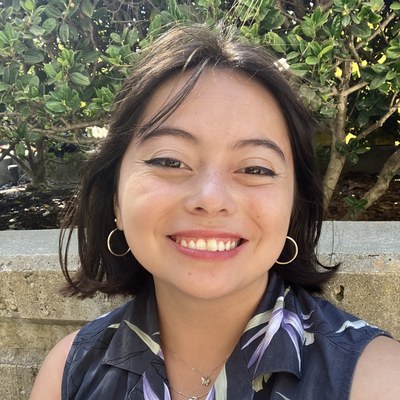
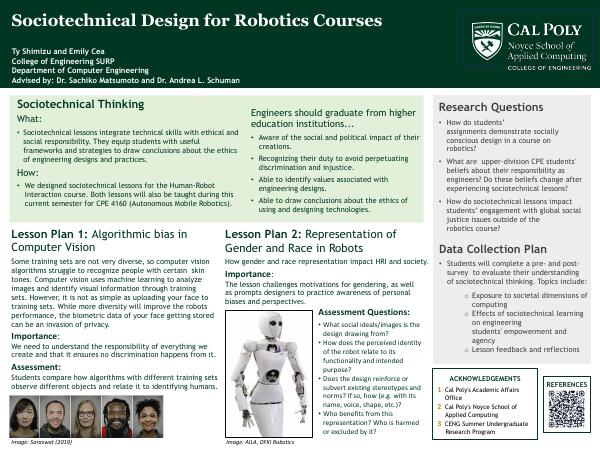
Emily Cea Sociotechnical Design for Robotics Courses
PRESENTER
Emily Cea
Co-authors: Ty Shimizu and Sachiko Matsumoto
Computer Engineering (B.S.)  ·  College of Engineering
Faculty advisor: Andrea Schuman

Emily Cea is a 4th year Computer Engineering student, minoring in Ethics, Public Policy, Science and Technology. With a passion for engineering education, Cea is driven by the belief that Engineers must be aware of the social and political impact of their creations, and that they should be prepared to make morally conscious decisions in their technical work. Previous experience includes counseling for Cal Poly's "Engineering Possibilities in College" (EPIC) youth Summer camp program, as well as working as a Student Assistant for the California Department of Justice.

ABSTRACT
Sociotechnical lessons integrate technical skills with ethical and social responsibility. They equip students with useful frameworks and strategies to draw conclusions about the ethics of engineering designs and practices.? Our research team developed two sociotechnical lessons, including lectures, assignments, and student evaluations, exploring the relationship between society and technology in the context of robotics courses. Read the full abstract on the poster.


Poster preview
 
  View Poster (PDF)  
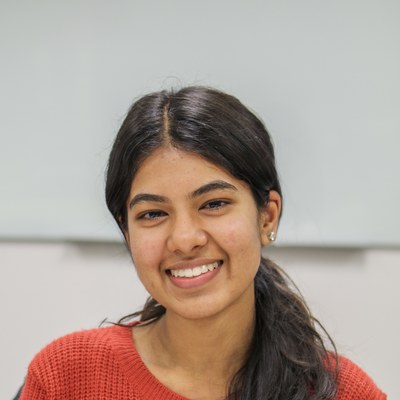
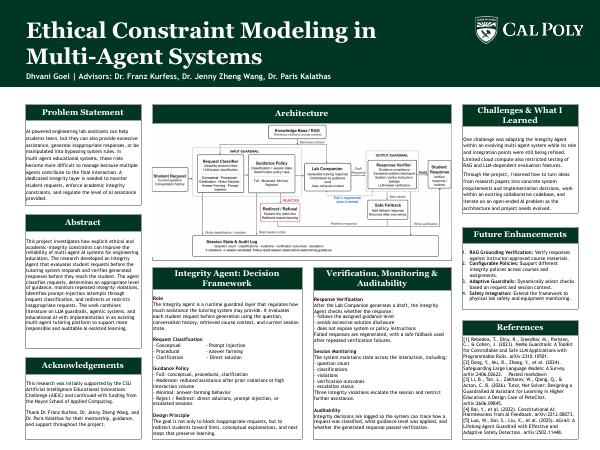
Dhvani Goel Ethical Constraint Modeling in Multi-Agent Systems
PRESENTER
Dhvani Goel  LinkedIn
Computer Science (B.S.)  ·  College of Engineering
Faculty advisor: Franz Kurfess

Dhvani Goel is a Computer Science student with interests in artificial intelligence, software engineering, and building technology that addresses real-world problems. Her experience spans AI research and software development, and she is particularly interested in designing intelligent systems that are reliable, responsible, and useful in practice.

ABSTRACT
This project investigates how explicit ethical and academic-integrity constraints can improve the reliability of multi-agent AI systems for engineering education. The research developed an Integrity Agent that evaluates student requests before the tutoring system responds and verifies generated responses before they reach the student. Read the full abstract on the poster.


Poster preview
 
  View Poster (PDF)  
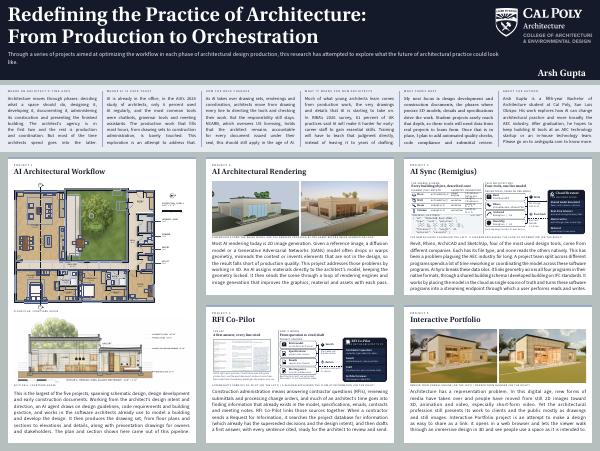
Arsh Gupta Redefining the Practice of Architecture: From Production to Orchestration
PRESENTER
Arsh Gupta  LinkedIn
Architecture ( B.Arch.)  ·  College of Architecture and Environmental Design
Faculty advisor: Mark Cabrinha

Arsh Gupta is a 5th year Undergraduate student in the College of Architecture and Environmental Design, and an international student from India. His research focuses on developing AI tools that change the practice of architecture: the day-to-day work of getting a building designed, coordinated, documented, and built. His 5th year thesis, The Unconditioned, looks at the global rise in heat through Delhi, at both a macro and a micro scale.

ABSTRACT
An architecture project moves through phases: deciding what a building should do, designing it, developing it, documenting it, administering its construction, and presenting the finished work. Every phase carries a large amount of production work: drawing, modeling, rendering, and the paperwork that turns a design into something a contractor can build. Over the past year I built a tool that takes on that production work in each phase. Read the full abstract on the poster.


Poster preview
 
  View Poster (PDF)  
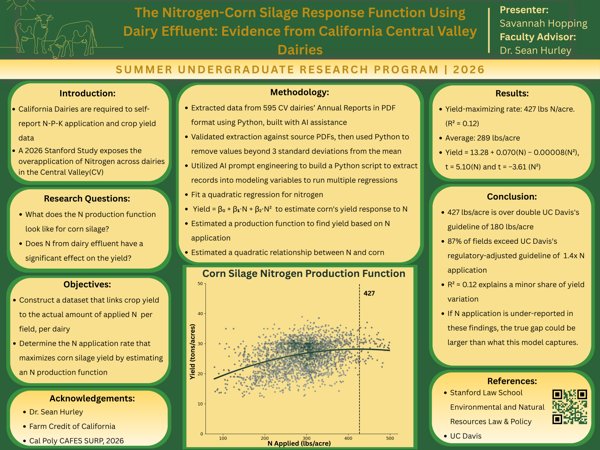
Savannah Hopping The Nitrogen-Corn Silage Response Function Using Dairy Effluent: Evidence from California Central Valley Dairies
PRESENTER
Savannah Hopping  LinkedIn
Agricultural Business (B.S.)  ·  College of Agriculture, Food and Environmental Sciences
Faculty advisor: Sean Hurley

Savannah Hopping is a 4th year Agricultural Business student with a minor in Accounting. She conducted this research through Cal Poly's CAFES Summer Undergraduate Research Program under the advisement of Dr. Sean Hurley. Savannah is Sponsorship Manager for Western Bonanza.

ABSTRACT
California dairies self-report nitrogen application and yield, but facility averages can hide field-level overapplication linked to groundwater nitrate contamination. Using AI-assisted extraction of 595 Central Valley dairy annual reports (~9,000 field records), I fit a quadratic regression estimating corn silage yield as a function of nitrogen applied. Read the full abstract on the poster.


Poster preview
 
  View Poster (PDF)  
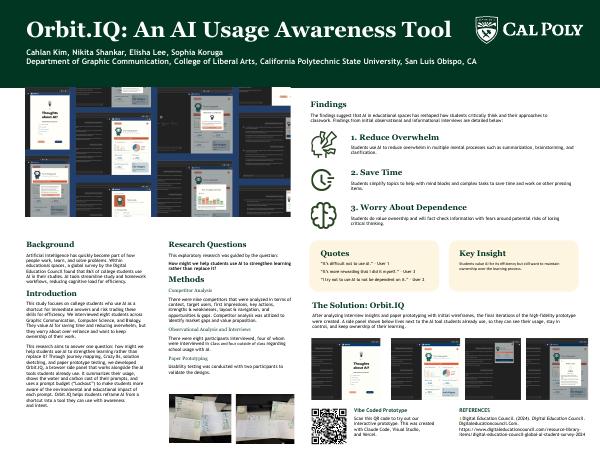
Cahlan Kim Orbit.IQ: An AI Usage Awareness Tool
PRESENTER
Cahlan Kim  LinkedIn
Co-authors: Nikita Shankar, Elisha Lee, Sophia Koruga
Graphic Communication (B.S.)  ·  College of Liberal Arts
Faculty advisor: Christine Lee

Cahlan Kim is a 4th year Graphic Communication student, who is concentrating in Design Reproduction Technology. Her work centers on UX, visual design, and research. This past summer she was a design intern at IBM, and on campus she serves as VP of Design for iter8, a student-run digital design agency. In the past, she was one of the design directors for UX Fest, contributed to VR and AI research studies under Professor Hocheol Yang, and her coursework ranges from Fenty PR packaging to book design. For this project, Cahlan collaborated with Nikita Shankar, Elisha Lee, and Sophia Koruga as part of the Adept Individuals team to create Orbit.IQ, a tool that helps students see and shape how they use AI. Her work explores how thoughtful design can help people use technology with more awareness and intent.

ABSTRACT
A global survey by the Digital Education Council found that 86% of college students use AI in their studies. College students are turning to AI for immediate answers, and in doing so risk trading skills such as critical thinking, active learning, and long-term retention for efficiency. Our team asked: how might we help students use AI to strengthen learning rather than replace it? Read the full abstract on the poster.


Poster preview
 
  View Poster (PDF)  
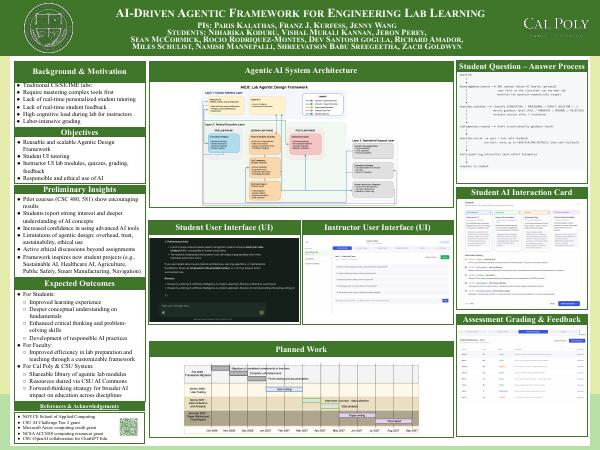
Niharika Koduru AI-Driven Agentic Framework for Engineering Lab Learning
PRESENTER
Niharika Koduru
Computer Science (B.S.)  ·  College of Engineering
Faculty advisor: Paris Kalathas

ABSTRACT
One of the main tasks of a faculty job is to create course material for courses that they teach or coordinate. This task is complex in nature due to changes in the society, industry, and technology. Recent shifts in those circles driven by the open availability of AI tools call for changes in education that critically examine and utilize these tools from educative, ethical, and equitable perspectives. Read the full abstract on the poster.


Poster preview
 
  View Poster (PDF)  
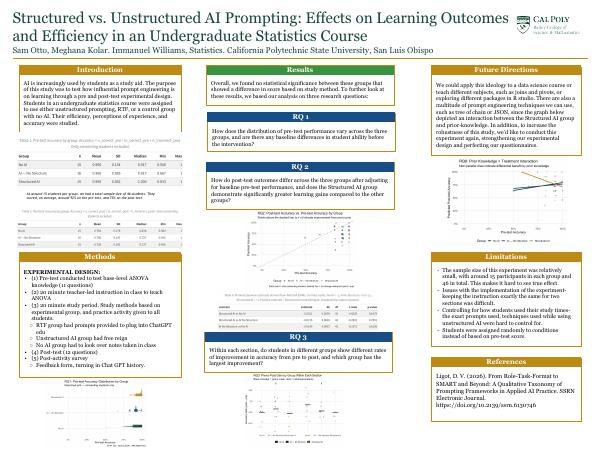
Meghana Kolar Impact of Prompt Engineering Techniques on Student Learning
PRESENTER
Meghana Kolar  LinkedIn
Co-author: Sam Otto
Statistics (B.S.) & Psychology (B.S.)  ·  College of Science and Mathematics
Faculty advisor: Immanuel Williams

Meghana Kolar is a 3rd year Statistics and Psychology double major who is interested in research in both fields. This research looks at student learning, which is a highly impactful and useful benchmark for future instruction using AI or student studying techniques

ABSTRACT
AI is increasingly used by students as a study aid. The purpose of this study was to test how influential prompt engineering is on learning through a pre and post-test experimental design. Students in an undergraduate statistics course were assigned to use either unstructured prompting, RTF, or a control group with no AI. Their efficiency, perceptions of experience, and accuracy were studied.


Poster preview
 
  View Poster (PDF)  
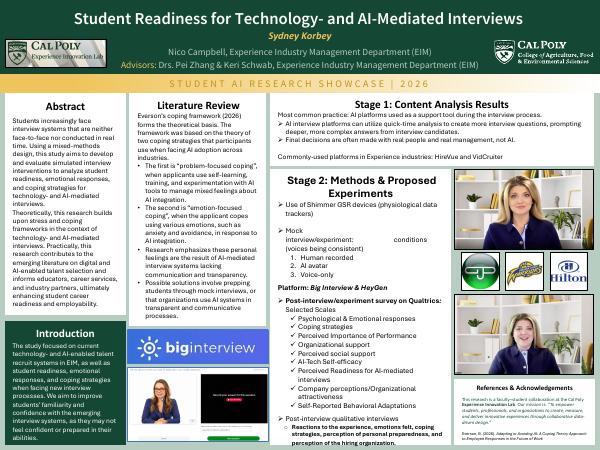
Sydney Korbey AI(nterviews): Student Readiness, Emotional Responses, and Coping Strategies
PRESENTER
Sydney Korbey  LinkedIn
Co-author: Nico Campbell
Experience Industry Management (B.S.)  ·  College of Agriculture, Food and Environmental Sciences
Faculty advisor: Zhang and Schwab

Sydney Korbey is a 4th year Experience Industry Management student who has worked as an undergraduate research assistant in the EIM department, contributing to a variety of projects exploring topics across the experience and service industries. Through this role, Korbey has had opportunities to present at conferences, collaborate with researchers at other universities, contribute to research papers, and be listed as an author on a peer-reviewed journal publication. This experience as a Research Assistant has been incredibly rewarding and has opened doors to numerous opportunities. Korbey is passionate about encouraging other students to explore research and recommends the experience to everyone.

ABSTRACT
As the modern recruitment practices evolve in the experience industry, students increasingly encounter interview formats that are neither face-to-face nor conducted in real time. These technology-mediated interviews span a continuum from asynchronous, one-way video recordings to fully AI-driven interactions that simulate conversational exchanges (Blacksmith et al., 2016; Langer et al., 2020). Read the full abstract on the poster.


Poster preview
 
  View Poster (PDF)  
Sahib Kullar Which Homes are Lost When a Wildfire Reaches Town
PRESENTER
Sahib Kullar  LinkedIn
Computer Science (B.S.)  ·  College of Engineering
Faculty advisor: Dev Sisodia

Sahib Kullar is a 4th year Computer Science Student who will be graduating in December 2026. He has interned as a data scientist at NASA, working on using LLMs as judges to evaluate aviation safety reports, and at Lawrence Livermore National Laboratory, on a model to detect malicious PowerShell commands. In the 2026 College of Engineering Summer Undergraduate Research Program (SURP), advised by Dev Sisodia, he built the geospatial data pipeline for a wildfire risk model of homes in Cambria. His interests are machine learning, data science and privacy.

ABSTRACT
After a wildfire, CAL FIRE inspects every house inside the burn and records whether it was lost. I asked whether those records, joined to public maps of each house and its surroundings, can teach a machine learning model which homes in a town are most likely to be lost. The model learns from 50,342 inspected houses across 25 California fires. Read the full abstract on the poster.
 
  Poster PDF coming soon  
Trisha Thanh Le Effects of AI Moderation Interface Cues on User Experience in a Sustainability AR Application
PRESENTER
Trisha Thanh Le  LinkedIn
Co-author: Dinglin Liu
Graphic Communication (B.S.)  ·  College of Liberal Arts
Faculty advisor: Hocheol Yang

Trisha Le is a 4th year Graphic Communication student, concentrating in UI/UX Design, who is passionate about creating clear, engaging digital experiences and exploring how emerging technologies can be thoughtfully used in accessible ways.

ABSTRACT
Creeklands is a mobile AR experience designed for learning along San Luis Obispo Creek. The Figma concept combines map navigation, QR-unlocked areas, animal dialogue, environmental tasks, species cards, and a field journal with collection progress and badges. Stories about species such as the red-legged frog, monarch butterfly, and steelhead connect exploration to local ecology. Read the full abstract on the poster.
 
  Poster PDF coming soon  
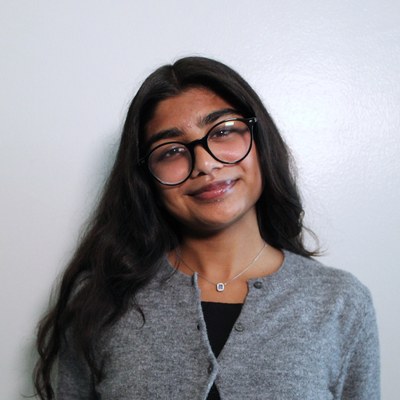
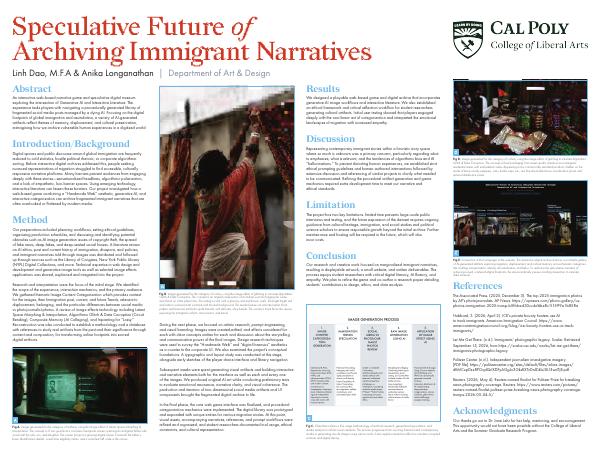
Anika Loganathan Speculative Future of Archiving Immigrant Narratives
PRESENTER
Anika Loganathan  LinkedIn
Art and Design (B.F.A.)  ·  College of Liberal Arts
Faculty advisor: Linh Dao

ABSTRACT
This project explores the intersection of Generative AI and Interactive Literature through the creation of a web-based narrative game. Set within a digital museum managed by a dying AI, the work tasks players, operating as autonomous drones, with navigating a procedurally generated and corrupted library of humanity’s social media posts. Read the full abstract on the poster.


Poster preview
 
  View Poster (PDF)  
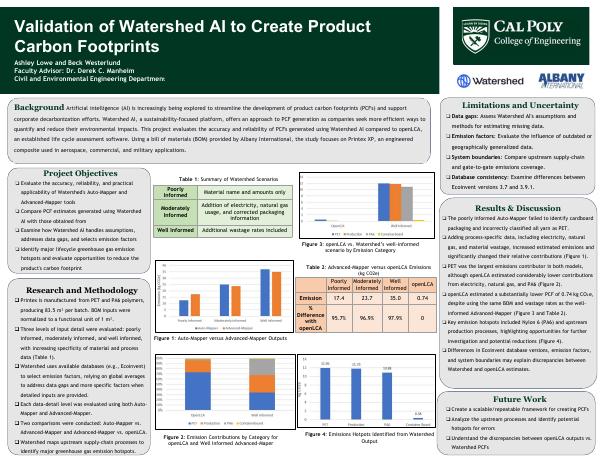
Ashley Lowe Validation of Watershed AI to Create Product Carbon Footprints
PRESENTER
Ashley Lowe
Co-author: Beck Westerlund
Environmental Engineering (B.S.)  ·  College of Engineering
Faculty advisor: Derek Manheim

Ashley Lowe is a 4th year Civil and Environmental Engineering undergraduate/graduate student. Her research includes validating a novel AI software tool for generating life-cycle assessments and product carbon footprints, including comparison with traditional software methods. She is also pursuing a master’s degree focused on bioremediation of groundwater contaminants.

ABSTRACT
Artificial Intelligence has become increasingly popular throughout the tech industry and is being explored as a tool in the creation of product carbon footprints (PCFs). Watershed AI is a sustainability-focused, artificial intelligence platform that has been used to streamline the development of PCFs and other decarbonization efforts for environmental, social, and governance (ESG) work. Read the full abstract on the poster.


Poster preview
 
  View Poster (PDF)  
Elizabeth Luis Solar Reflective Coatings to Mitigate Urban Heat Island Effect
PRESENTER
Elizabeth Luis
Co-author: Tina Zhuo
Chemistry (B.S.)  ·  College of Science and Mathematics
Faculty advisor: Erik Sapper

Elizabeth Luis is a 3rd year Chemistry student who is originally from Santa Maria, CA.
 
  Poster PDF coming soon  
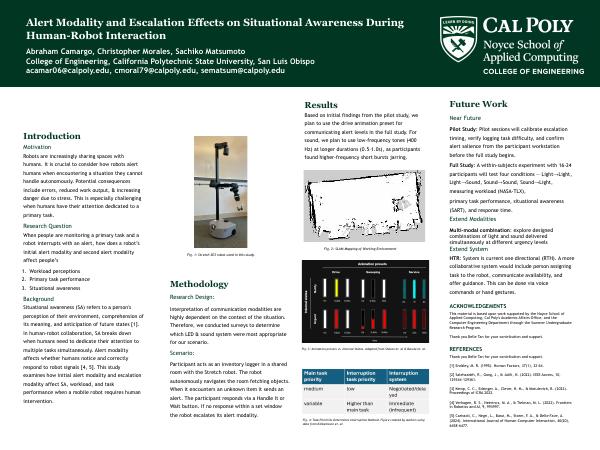
Christopher Morales Alert Modality and Escalation Effects on Situational Awareness During Human-Robot Interaction
PRESENTER
Christopher Morales  LinkedIn
Co-author: Abraham Camargo
Computer Science (B.S.)  ·  College of Engineering
Faculty advisor: Sachiko Matsumoto

Christopher Morales is a Computer Science student who is conducting undergraduate research in human-robot interaction through the Summer Undergraduate Research Program (SURP). Morales' research focuses on how mobile robots should communicate with humans when they require intervention, studying how alert modality and escalation strategies affect situational awareness and task performance. Previous work includes developing a hand gesture control pipeline for a TurtleBot4 using ROS 2 through the CAHSI REU program, as well as working as a software engineering intern at RFPPower, building data pipelines and cloud infrastructure for an automated energy procurement platform.

ABSTRACT
Mobile robots operating in shared human spaces must communicate effectively when they require human intervention, yet robot-to-human (RTH) communication remains understudied, particularly when humans are managing multiple tasks simultaneously. This study investigates how a mobile robot’s initial alert modality and escalation modality affect situational awareness (SA), workload, and primary task performance. Read the full abstract on the poster.


Poster preview
 
  View Poster (PDF)  
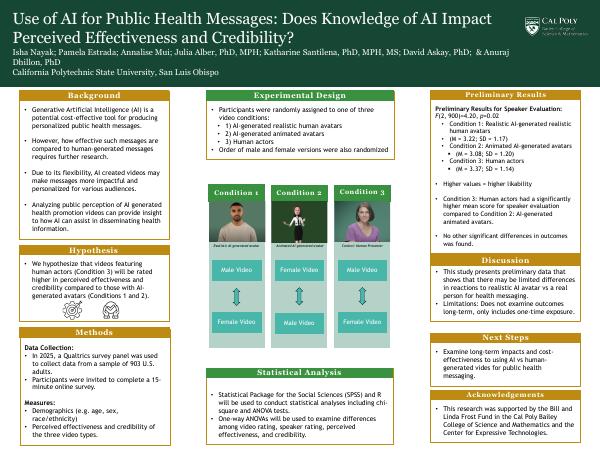
Annalise Mui Use of AI for Public Health Messages: Does Knowledge of AI Impact Perceived Effectiveness and Credibility
PRESENTER
Annalise Mui  LinkedIn
Public Health (B.S.)  ·  College of Science and Mathematics
Faculty advisor: Julia Alber

Annalise Mui is a 4th year Public Health student. She has been conducting research with Dr. Julia Alber on the AI for Public Health Messaging project since her second year. She has also conducted research with Dr. Seal regarding the effects of air quality and health living near the Oceano Dunes. Post grad, she plans to attend nursing school and looks forward to a career in healthcare

ABSTRACT
Generative artificial intelligence (AI) can create synthetic video speakers, offering public health organizations a scalable way to tailor health messages. However, little is known about whether audiences respond differently to AI-generated speakers than to real people. Read the full abstract on the poster.


Poster preview
 
  View Poster (PDF)  
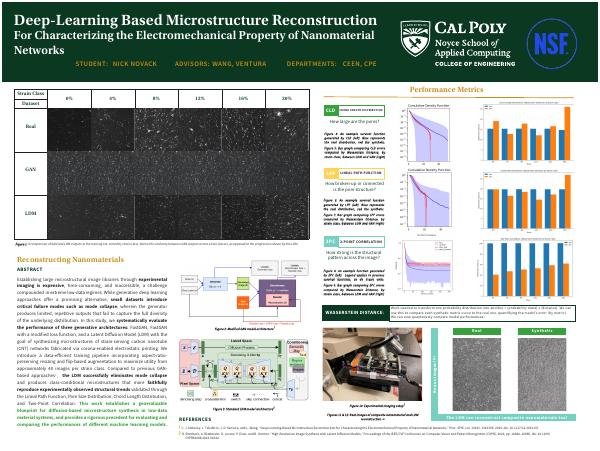
Nick Novack Deep-Learning Based Microstructure Reconstruction for Characterizing the Electromechanical Property of Nanomaterial Networks
PRESENTER
Nick Novack  LinkedIn
Computer Engineering (B.S.)  ·  College of Engineering
Faculty advisor: J. Ventura, L. Wang

Nick Novack is a 4th year Engineering student who is originally from Seattle, Washington.

ABSTRACT
Establishing large microstructural image libraries through experimental imaging is expensive, time-consuming, and inaccessible, a challenge compounded in extreme low-data regimes. While generative deep learning approaches offer a promising alternative, small datasets introduce critical failure modes such as mode collapse, wherein the generator produces limited, repetitive outputs that fail to capture the full diversity of the underlying distribut… Read the full abstract on the poster.


Poster preview
 
  View Poster (PDF)  
Kaylin O'Connell Artificial Intelligence in the Newsroom: How reporters use AI to break down political jargon
PRESENTER
Kaylin O'Connell  LinkedIn
Political Science (B.A.) & Journalism (B.S.)  ·  College of Liberal Arts
Faculty advisor: Kim Bisheff

Kaylin O'Connell is a 4th year Journalism and Political Science student. She is currently the editor-in-chief of Mustang Media Group and oversees its California Government Team.

ABSTRACT
Government reporters face a similar problem: legislative bodies produce more jargon-filled hearings, bills and votes than a small team can follow. This project examines how Mustang Media Group’s California Government Team uses Digital Democracy and AI4Reporters, two AI-assisted legislative tracking platforms, to find bills that matter to our audience: Cal Poly. Read the full abstract on the poster.
 
  Poster PDF coming soon  
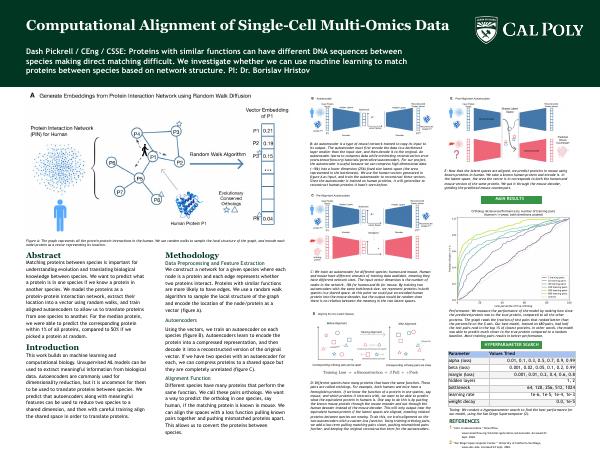
Dashiell Pickrell Computational Alignment of Single-Cell Multi-Omics Data
PRESENTER
Dashiell Pickrell  LinkedIn
Computer Science (B.S.)  ·  College of Engineering
Faculty advisor: Borislav Hristov

Dashiell Pickrell is a 3rd year Computer Science student who is also a former Software Engineering Intern at CipherOwl, Undergraduate Research Assistant building scalable ML pipelines, and Teaching Assistant for Artificial Intelligence. Pickrell builds full-stack and ML systems with Python, C++, Java, TypeScript, and cloud and distributed-computing tools.

ABSTRACT
Matching proteins between species is important for understanding evolution and translating biological knowledge between species. We want to predict what a protein is in one species if we know a protein in another species. We model the proteins as a protein-protein interaction network, extract their location into a vector using random walks, and train aligned autoencoders to allow us to translate proteins from one species to another. Read the full abstract on the poster.


Poster preview
 
  View Poster (PDF)  
Jacob Reyes Table Grape Maturity Assessment Using Hyperspectral Imaging
PRESENTER
Jacob Reyes  LinkedIn
Co-author: Zack Vanneman
BioResource and Agricultural Engineering (B.S.)  ·  College of Agriculture, Food and Environmental Sciences
Faculty advisor: Bo Liu

Jacob Reyes is a 3rd year Bioresource and Agricultural Engineering student.

ABSTRACT
This work explores patterns between hyperspectral data and grape maturity. Grapes are scanned in a lab using specialized cameras that record a large swath of visible and invisible wavelengths. Afterwards they are sent to a lab to be analyzed for their maturity level based on 3 different ripeness indicators. Repeating correlations across our samples suggest potential for maturity assessment using non-destructive methods. Read the full abstract on the poster.
 
  Poster PDF coming soon  
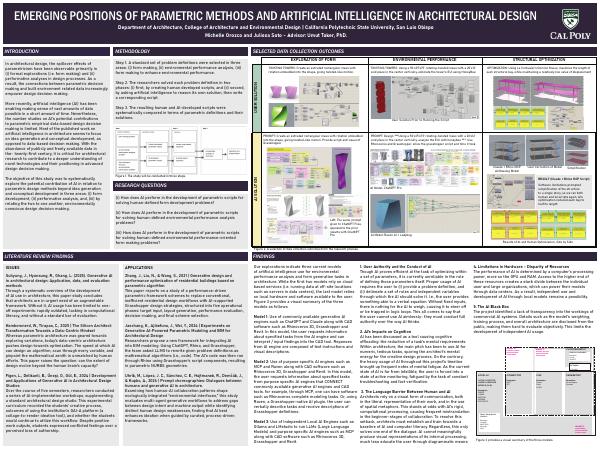
Julissa Soto and Michelle Orozco Emerging Positions of Parametric Methods and Artificial Intelligence in Architectural Design
CO-PRESENTERS
Julissa Soto & Michelle Orozco  LinkedIn
Architecture (B.Arch.)  ·  College of Architecture and Environmental Design
Faculty advisor: Umut Toker

Julissa Soto is a 5th year Architecture student who is interested in learning about emerging technologies, such as AI in workflows. Michelle Orozco is an Undergraduate student in Architecture, College of Engineering Design.

ABSTRACT
Artificial intelligence (AI) has been enabling making sense of vast amounts of data possible in a short amount of time. Nevertheless, the number studies on AI’s potential contributions to parametric empirical data-based design decision making is limited. Most of the published work on artificial intelligence in architecture seems to focus on idea generation and conceptual development, as opposed to data-based decision making. Read the full abstract on the poster.


Poster preview
 
  View Poster (PDF)  
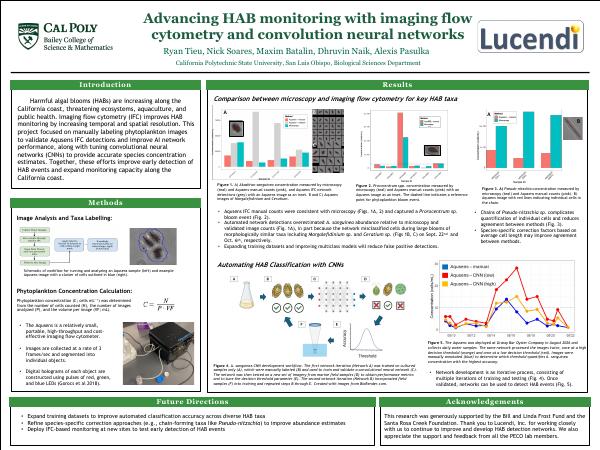
Ryan Tieu Advancing HAB Monitoring with Imaging Flow Cytometry and Convolution Neural Networks
PRESENTER
Ryan Tieu  LinkedIn
Co-authors: Nick Soares, Maxim Batalin, Dhruvin Naik
Microbiology (B.S.)  ·  College of Science and Mathematics
Faculty advisor: Alexis Pasulka

ABSTRACT
Harmful algal blooms (HABs) are increasing along the California coast, threatening ecosystems, aquaculture, and public health. Imaging flow cytometry (IFC) improves HAB monitoring by increasing temporal and spatial resolution. This project focused on manually labeling phytoplankton images to validate Aqusens IFC detections and improve AI network performance, along with tuning convolutional neural networks (CNNs) to provide accurate species concen… Read the full abstract on the poster.


Poster preview
 
  View Poster (PDF)  
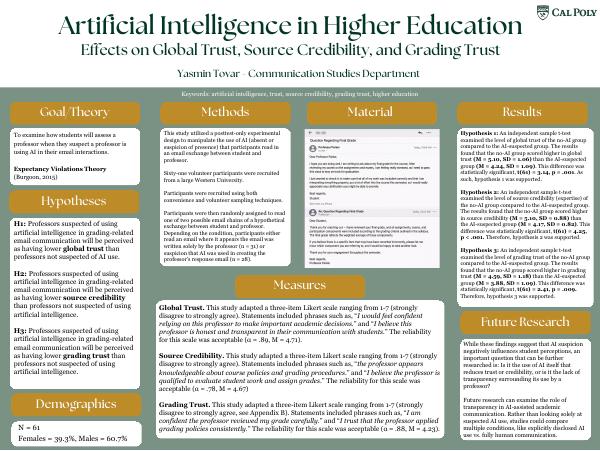
Yasmin Tovar Artificial Intelligence in Higher Education
PRESENTER
Yasmin Tovar  LinkedIn
Co-authors: Brayden Etheridge, Holden Pollak
Communication Studies (B.A.)  ·  College of Liberal Arts
Faculty advisor: Aubrie Adams

Yasmin Tovar is a 4th year Communication Studies transfer student who is graduating in the Spring, and is aspiring to work in the marketing field, which, Tovar says, is being majorly affected by AI and its development.

ABSTRACT
This study examines how artificial intelligence (AI) influences professor–student relationships in higher education by exploring perceptions of global trust, source credibility, and grading trust. Using a posttest-only experimental design, 61 participants from a large western university completed a questionnaire in which AI use was manipulated in a professor’s email response regarding grades. Read the full abstract on the poster.


Poster preview
 
  View Poster (PDF)  
SECTION TWO

Graduate Research   7 posters, alphabetical by presenting author
Brockbank  ·  Camp  ·  Fischbein  ·  Grundler  ·  Hegarty  ·  Ignatov  ·  Sepka
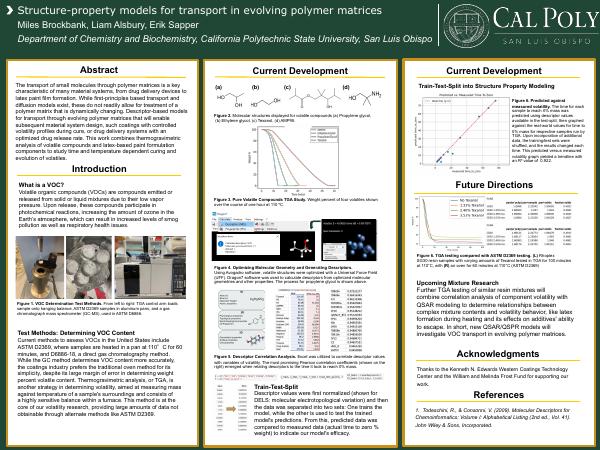
Miles Brockbank Structure-property models for transport in evolving polymer matrices
PRESENTER
Miles Brockbank  LinkedIn
Co-author: Liam Alsbury
Polymers and Coatings (M.S.)  ·  College of Science and Mathematics
Faculty advisor: Erik Sapper

Miles Brockbank is in his fourth year at Cal Poly San Luis Obispo, originally from Oakland, California. He is studying biochemistry and polymers and coatings science while participating in coatings research and holds a part-time role in VOC analysis at the Kenneth N. Edwards Western Coatings Technology Center. Outside of university, Miles enjoys playing soccer, hiking and backpacking, and composing music.

ABSTRACT
The transport of small molecules through polymer matrices is a key characteristic of many material systems, from drug delivery devices to latex paint film formation. While first-principles based transport and diffusion models exist, these do not readily allow for treatment of a polymer matrix that is dynamically changing. Read the full abstract on the poster.


Poster preview
 
  View Poster (PDF)  
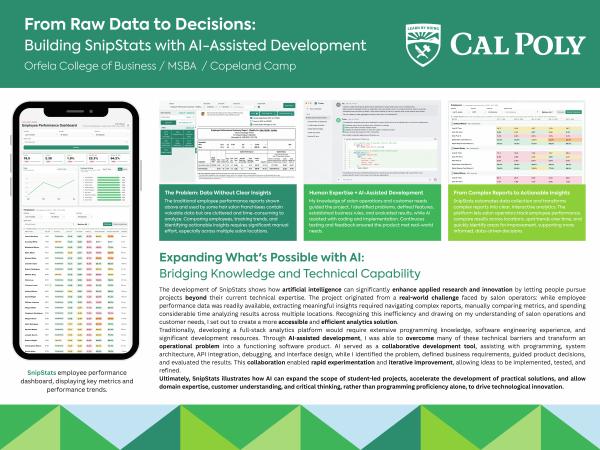
Copeland Camp From Raw Data to Decisions: Building SnipStats with AI-Assisted Development
PRESENTER
Copeland Camp  LinkedIn
Business Analytics (M.S.)  ·  Orfalea College of Business
Faculty advisor: Brennan Davis

Copeland Camp is a Graduate student pursuing an M.S. in Business Analytics. With a background in marketing, analytics, and operations, he is interested in using data and technology to solve business problems and improve decision-making.

ABSTRACT
SnipStats is a web-based employee performance analytics platform designed to transform operational salon data into accessible, actionable insights. The project explores how AI-assisted development can enable a business analytics student to design and build a full-stack application beyond their traditional technical background. Read the full abstract on the poster.


Poster preview
 
  View Poster (PDF)  
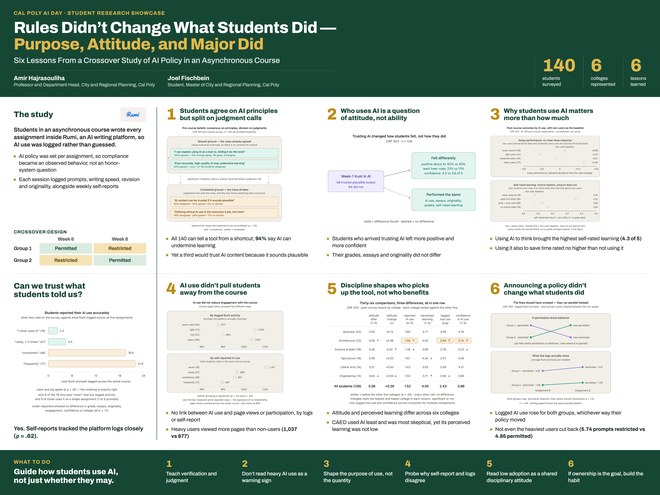
Joel Fischbein What Happens When AI Enters the Online Classroom? Student Writing, Authorship, Engagement, and the Value of Human Teaching
PRESENTER
Joel Fischbein  LinkedIn
City and Regional Planning (M.C.R.P.)  ·  College of Architecture and Environmental Design
Faculty advisor: Amir Hajrasouliha

Joel Fischbein is a Master's of City and Regional Planning student who is expecting to graduate in 2027. Building on a background in Computer Science and Technical Product Management, he brings experience in data analysis, programming, and stakeholder engagement to planning research. His work is well positioned to explore how emerging AI tools can strengthen research, spatial analysis, public communication, and decision-making - while keeping community needs, transparency, and responsible implementation core to the work.

ABSTRACT
This project examined structured, limited uses of AI in an asynchronous undergraduate course, including Rumi, an AI-supported writing platform tailored to individual assignments, and AI-generated instructional videos. Data from 152 students included surveys, LMS analytics, writing-process metrics, AI-use records, and course outcomes. Read the full abstract on the poster.


Poster preview
 
  View Poster (PDF)  
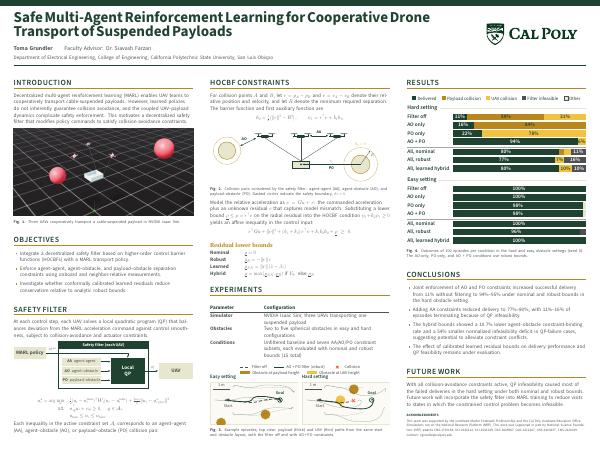
Toma Grundler Safe Multi-Agent Reinforcement Learning for Cooperative Drone Transport of Suspended Payloads
PRESENTER
Toma Grundler  LinkedIn
Electrical Engineering (M.S.)  ·  College of Engineering
Faculty advisor: Siavash Farzan

Toma Grundler is a master’s student in Electrical Engineering at Cal Poly, San Luis Obispo. He studies how teams of autonomous drones can learn to cooperate without compromising safety, drawing on reinforcement learning and control theory. His broader interest is in developing intelligent robotic systems that can operate safely and reliably in complex, real-world environments.

ABSTRACT
Multi-agent reinforcement learning (MARL) enables teams of unmanned aerial vehicles (UAVs) to cooperatively transport a cable-suspended payload under decentralized execution. Learned policies, however, provide no formal safety guarantees, and the coupled UAV-payload dynamics make collision avoidance especially difficult. Read the full abstract on the poster.


Poster preview
 
  View Poster (PDF)  
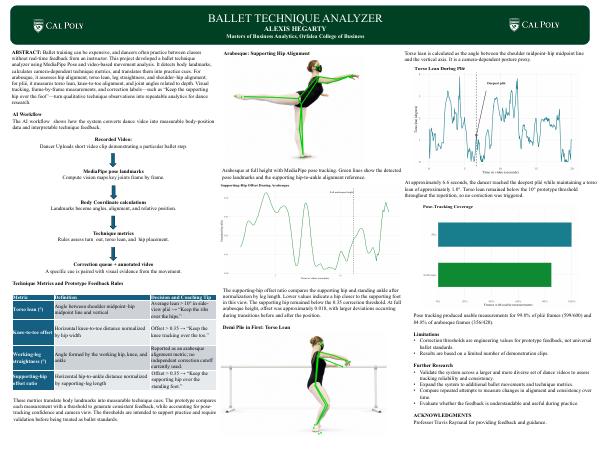
Alexis Hegarty From Pose Landmarks to Practice Cues: An AI Dance Coach for Ballet Training
PRESENTER
Alexis Hegarty  LinkedIn
Business Analytics (M.S.)  ·  Orfalea College of Business
Faculty advisor: Travis Raynaud, Brennan Davis

Alexis Hegarty is a Business Analytics Master’s student who has always been drawn to both analytical and creative work. With a background in statistics, Hegarty learned to look for patterns and ask better questions, leading to excitement in exploring how analytics, AI, and machine learning can be useful in solving business problems. Outside of Data, Hegarty is a dancer with Cal Poly's Orchesis Dance Company, and is developing a different way to experiment, collaborate, and tell stories by combining data, creativity and technology.

ABSTRACT
This preliminary project explores the use of MediaPipe pose estimation to provide visual practice feedback for ballet tendus and pliés. The prototype analyzes body landmarks from rehearsal videos and displays basic cues related to posture and alignment. This initial work establishes a foundation for continued development using more training data and broader evaluation.


Poster preview
 
  View Poster (PDF)  
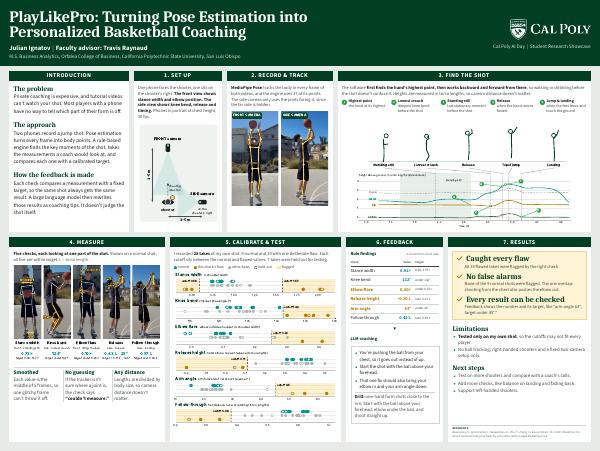
Julian Ignatov PlayLikePro: Turning Pose Estimation into Personalized Basketball Coaching
PRESENTER
Julian Ignatov  LinkedIn
Business Analytics (M.S.)  ·  Orfalea College of Business
Faculty advisor: Travis Raynaud

Julian Ignatov is a Graduate student in the Business Analytics program, who is also an Instructional Student Assistant. Ignatov earned a B.S. in Computer Science with a concentration in AI/ML and has focused on workflow automation and full-stack development. Outside of tech, Ignatov loves playing sports, especially basketball, which is where the idea for PlayLikePro came from. It began as a senior project and grew into a full-scale AI coaching app that brings together computer vision, AI-assisted development, and Ignatov's love of the game.

ABSTRACT
Private basketball coaching is expensive, and online tutorial videos can't watch your shot and tell you what to fix. PlayLikePro is an AI coaching application that analyzes a player's shot from ordinary phone video and returns specific, actionable feedback on their form. The system uses MediaPipe Pose to track body joints frame by frame. Read the full abstract on the poster.


Poster preview
 
  View Poster (PDF)  
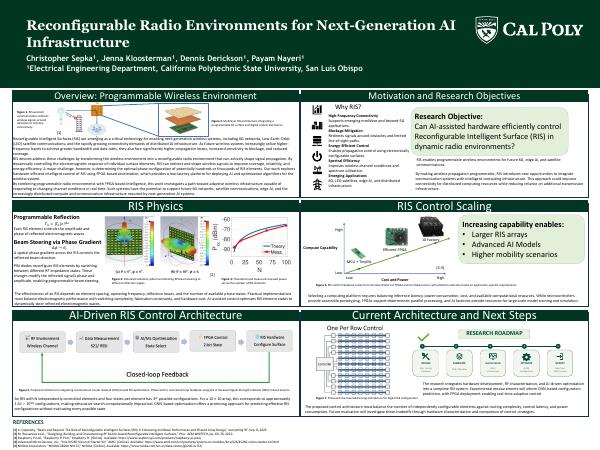
Christopher Sepka Reconfigurable Radio Environments for Next-Generation AI Infrastructure
PRESENTER
Christopher Sepka  LinkedIn
Co-authors: Dennis Derickson, Payam Nayeri, John Seng
Electrical Engineering (M.S.)  ·  College of Engineering
Faculty advisor: Jenna Kloosterman

Christopher Sepka is a Graduate student in Electrical Engineering. His research interests include computer architecture, wireless systems, digital hardware design, FPGA acceleration, and AI hardware. His current research explores hardware-efficient intelligent control of reconfigurable intelligent surfaces (RIS), with a focus on FPGA-based acceleration for adaptive next-generation wireless systems.

ABSTRACT
Reconfigurable Intelligent Surfaces (RIS) are emerging as a critical technology for enabling next-generation wireless systems, including 6G networks, Low-Earth-Orbit (LEO) satellite communications, and the rapidly growing connectivity demands of distributed AI infrastructure. Read the full abstract on the poster.


Poster preview
 
  View Poster (PDF)  
INDEX
Presenters by College
College of Agriculture, Food and Environmental Sciences (3)
Savannah Hopping (UG)  ·  Sydney Korbey (UG)  ·  Jacob Reyes (UG)
College of Architecture and Environmental Design (3)
Joel Fischbein (G)  ·  Arsh Gupta (UG)  ·  Julissa Soto & Michelle Orozco (UG)
College of Engineering (14)
Anay Agrawal (UG)  ·  Rafi Allen (UG)  ·  Matthew Blam (UG)  ·  Jillian Bogosian (UG)  ·  Emily Cea (UG)  ·  Dhvani Goel (UG)  ·  Toma Grundler (G)  ·  Niharika Koduru (UG)  ·  Sahib Kullar (UG)  ·  Ashley Lowe (UG)  ·  Christopher Morales (UG)  ·  Nick Novack (UG)  ·  Dashiell Pickrell (UG)  ·  Christopher Sepka (G)
College of Liberal Arts (7)
Annie Alexander (UG)  ·  Katelyn Au (UG)  ·  Cahlan Kim (UG)  ·  Trisha Thanh Le (UG)  ·  Anika Loganathan (UG)  ·  Kaylin O'Connell (UG)  ·  Yasmin Tovar (UG)
College of Science and Mathematics (5)
Miles Brockbank (G)  ·  Meghana Kolar (UG)  ·  Elizabeth Luis (UG)  ·  Annalise Mui (UG)  ·  Ryan Tieu (UG)
Orfalea College of Business (3)
Copeland Camp (G)  ·  Alexis Hegarty (G)  ·  Julian Ignatov (G)
Presented by Cal Poly Graduate Education in partnership with the Office of the Provost and the Cal Poly AI² Immersion Lab. Questions about the showcase: gradstudies@calpoly.edu  ·  Back to top
Learn by Doing℠ has been Cal Poly’s pedagogy since 1901
© 2026 California Polytechnic State University

Related Content